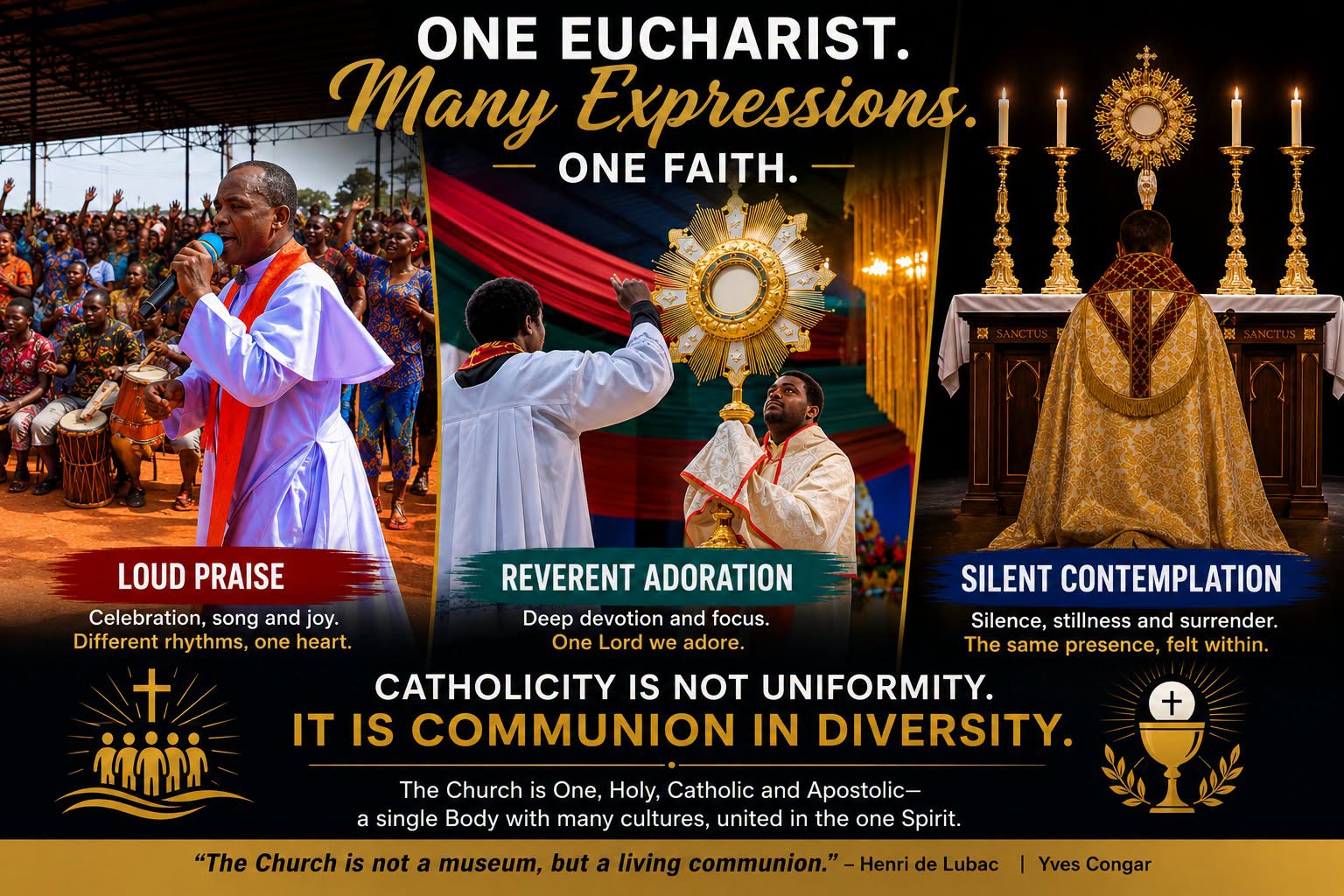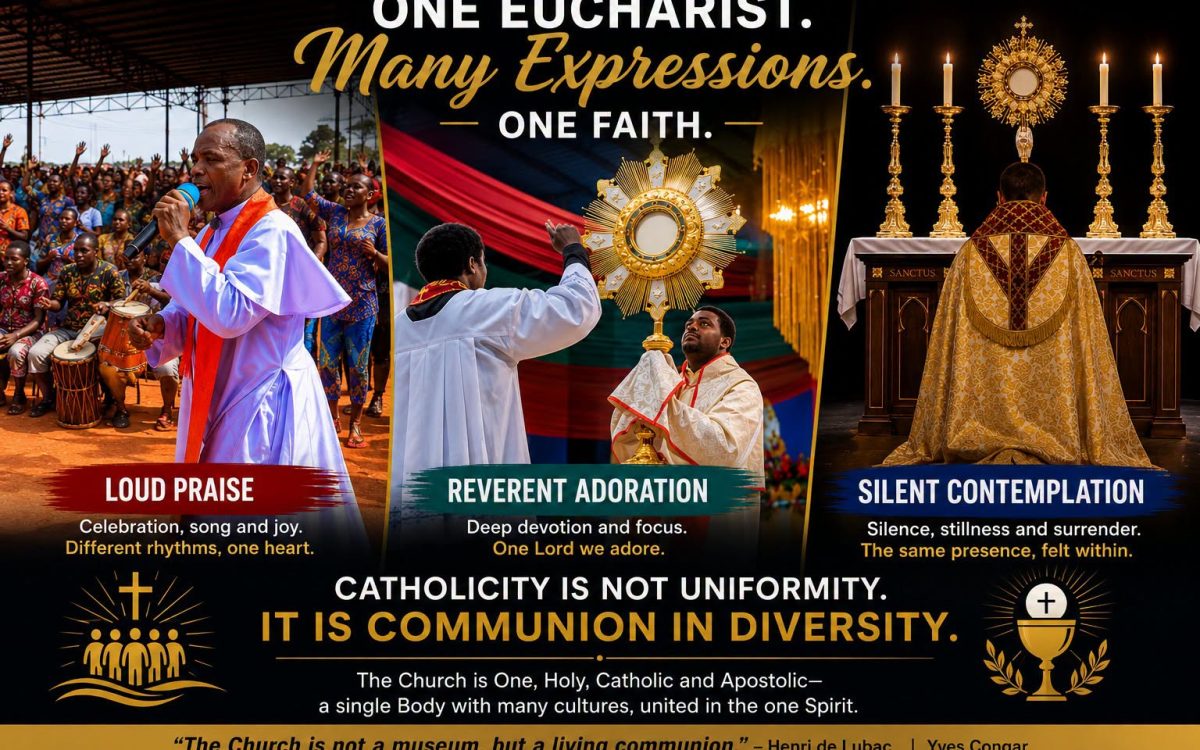
You must have seen people criticize Frs. Mbaka, Ebube Muonso, and others for the way they conduct Eucharistic Adoration.

The common complaint is that their worship is “not Catholic enough.” It is considered too loud, too emotional, or insufficiently solemn and monastic.
But perhaps the deeper problem lies in how we understand Catholicity.
Catholicity Does Not Mean Uniformity
The word Catholic is traditionally associated with the Greek kata holon—“according to the whole.” It points to fullness, not sameness. The Church is one Body, but her members come from different peoples, cultures, and histories.
Catholicism is lived by real people in real places. Context matters.
Yet many of us have unconsciously accepted the idea that worship is truly Catholic only when it looks Western, sounds monastic, or imitates European forms of piety.
But where did Christ say that?
Must African Worship Sound European?
Does God understand only one language of worship?
Who says that Jesus cannot be praised with the ogene, the udu, the talking drum, or another instrument through which a people offer their hearts to God?
Scripture presents encounters with God in different ways. Elijah encountered God in the gentle whisper. Israel encountered God amid thunder, lightning, fire, and cloud. The Psalms call people to praise God with trumpets, strings, cymbals, and dancing.
Silence can lead us to God. So can song, rhythm, and joyful movement.
Fidelity Is Not Cultural Imitation
Certainly, not every practice becomes acceptable simply because it is culturally expressive. Catholic worship still requires discernment, reverence, order, and fidelity to the Church. Inculturation is not permission for a priest to do whatever he wishes.
But fidelity should not be confused with cultural imitation.
The Second Vatican Council teaches that the Church does not wish to impose “a rigid uniformity” in matters that do not affect the faith or the good of the community. She respects the gifts of different peoples and can welcome cultural elements that harmonize with the authentic spirit of the liturgy.
The proper question, therefore, is not whether African worship resembles worship in a European monastery.
We should ask whether it is faithful to Christ, respectful of the Eucharist, consistent with the Church’s norms, and capable of drawing people into communion with God.
Legitimate concerns may still be raised about personality cults, emotional manipulation, political preaching, finances, or liturgical discipline. But these concerns should be addressed directly. They should not be disguised as the assumption that African expressiveness is inherently irreverent.
One Faith, Many Cultural Expressions
Catholicity is not about doing everything in one way.
It is about belonging to the one Body of Christ while allowing every people to bring their gifts, music, symbols, and cultural memory into that communion.
Communion does not erase difference.
It gathers differences into one Body.
Reference: Second Vatican Council, Sacrosanctum Concilium, 22 and 37–40.